Results
The Results phase presents the outcome of your Double Materiality Assessment, showing which ESG topics have been identified as material for your organization. This page explains how materiality scores are calculated, how to interpret the results, and how to finalize your material topics.
How materiality scores are calculated
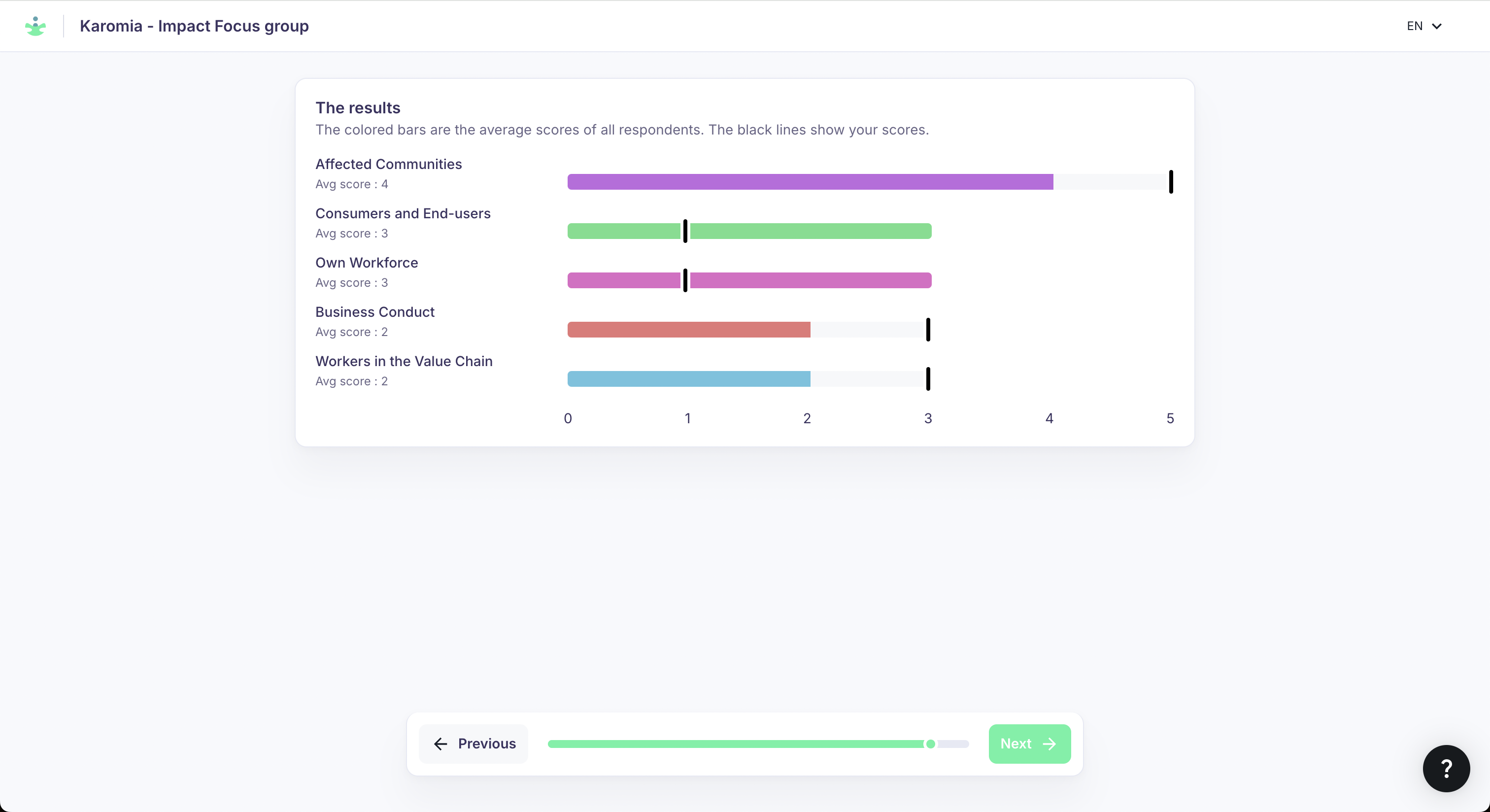
Karomia uses a multi-layered aggregation methodology that accounts for response type, stakeholder expertise, data collection method, and stakeholder-topic relevance.
Subscore formulas
Each individual stakeholder response is first converted into a subscore based on the type of IRO:
| IRO type | Formula |
|---|---|
| Positive impact | Likelihood x (Scale + Scope) / 2 |
| Negative impact | Likelihood x (Scale + Scope + Irremediability) / 2 |
| Financial (risk or opportunity) | Likelihood x Magnitude |
Weighting layers
Three weighting factors are applied to each subscore before aggregation:
Expertise weight The respondent's self-reported expertise level determines the weight of their response:
| Expertise level | Multiplier |
|---|---|
| Little knowledge | x1 |
| Stay informed | x2 |
| Expert | x3 |
For focus groups, the participant count is used as the expertise weight.
Method weight The data collection method determines an additional weight:
| Method | Multiplier |
|---|---|
| Survey | x1 |
| Interview | x3 |
| Focus group | x6 |
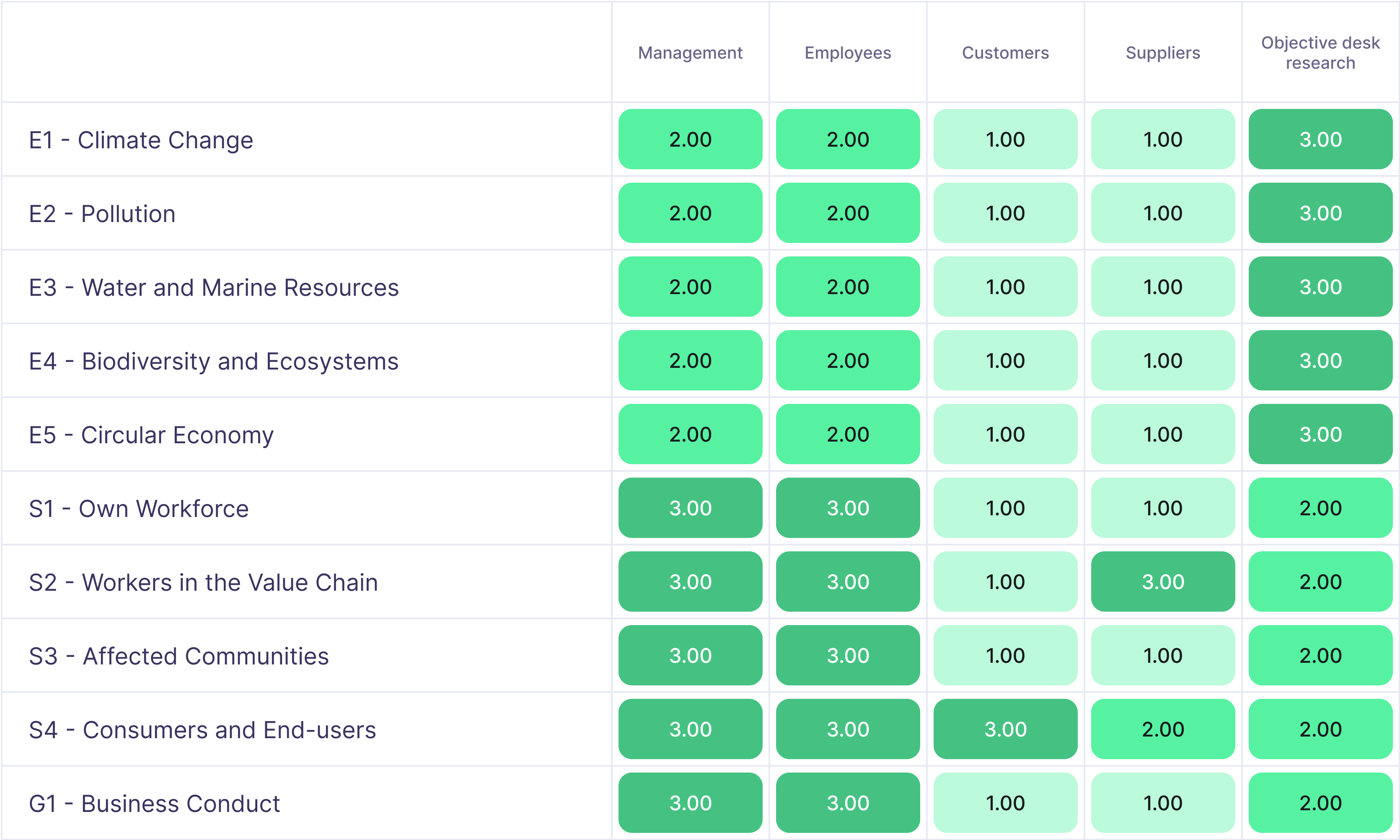
Stakeholder-topic weight The weight assigned to each stakeholder group per topic during the IRO analysis phase:
| Weight level | Multiplier |
|---|---|
| Low | x1 |
| Normal | x3 |
| High | x6 |
Aggregation process
The aggregation follows these steps:
- Weighted subscores — Each individual response subscore is multiplied by the expertise weight, method weight, and stakeholder-topic weight.
- Maximum per IRO type — For each ESRS subtopic, the maximum weighted score is taken per IRO type (positive impact, negative impact, financial risk, financial opportunity).
- Min/max normalization — Scores are normalized across all subtopics to produce comparable values.
- Separate treatment of positive and negative impacts — Positive impacts do not offset negative impacts. They are tracked independently to ensure that negative impacts are not masked by positive contributions.
Materiality matrix
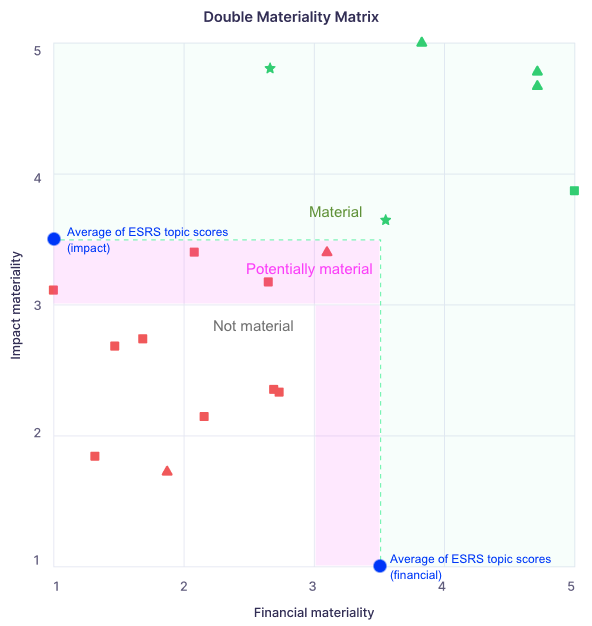
The materiality matrix visualizes all assessed subtopics on a two-dimensional chart:
- X-axis — Financial materiality (risks and opportunities for your organization).
- Y-axis — Impact materiality (your organization's effects on environment and society).
Threshold definition
Karomia applies the following default thresholds to categorize each subtopic:
| Category | Threshold | Meaning |
|---|---|---|
| Material | Score above the average across all subtopics | The subtopic is considered material and requires ESRS disclosure. |
| Undecided | Score between the average and 3 | The subtopic is in a grey zone that requires further investigation. |
| Not material | Score below 3 | The subtopic is not considered material. |
The final list of material topics determines which ESRS disclosure requirements apply to your organization's sustainability report.
Investigating results
Top-down approach
Review results using a top-down approach:
- Topic level — Start by examining which ESRS topics (e.g., E1 Climate Change, S1 Own Workforce) show the highest materiality scores.
- Subtopic level — Drill down into individual subtopics within each topic to understand which specific areas are driving materiality.
- Stakeholder input — Review how different stakeholder groups scored each subtopic to understand differing perspectives.
Reviewing individual topics
Click on any topic to see the detailed scoring breakdown, including:
- Scores by stakeholder group.
- Scores by IRO type (positive impact, negative impact, financial risk, financial opportunity).
- Qualitative comments from stakeholders.
Handling undecided topics
Subtopics that fall in the Undecided category require careful review before you can finalize the assessment. For each undecided subtopic:
Consensus analysis
Examine whether stakeholder groups are aligned or divided:
- If most groups scored the subtopic similarly, the score is likely reliable.
- If there is significant divergence between groups, further investigation may be needed.
Stakeholder comments
Review the qualitative comments provided by stakeholders during data collection. These can provide important context that the quantitative scores alone do not capture.
Final judgement
For each undecided subtopic, you must make a final determination:
- Lock on average — Accept the calculated score and let the threshold determine materiality.
- Move to 3 — Manually set the score to 3 (the lower bound of the undecided range), effectively classifying it as not material.
Document your rationale for each decision, as this will be included in the assessment report and may be reviewed by auditors.
Exporting results
You can export your assessment results in various formats for use in presentations, board meetings, or as input for your sustainability report:
- Charts and visualizations.
- Detailed topic-level breakdowns.
- Summary reports.
Next steps
- Reporting — Generate reports from your assessment.
- Create a sustainability report — Use your DMA results as the basis for your CSRD report.